
Surviving the Peak: When Your Cooling System Struggles to Keep Up
Our team at Scully's Air knows firsthand that August in the Central Valley is unforgiving, and your cooling equipment has likely been working overtime since May. You are not alone if you find yourself staring at a thermostat that refuses to drop below 78 degrees, even while the system runs continuously. Before the next wave of extreme weather hits, running through a targeted seasonal home maintenance checklist is the best way to determine if your equipment is simply strained or actively failing.
If you are considering whether you need an AC installation or just a thorough tune-up for your existing Air Conditioning system, you have a critical decision to make. Do you cross your fingers and hope the system survives the rest of the season, or do you take action now to prevent a complete breakdown? End-of-season wear compounds rapidly. A unit that struggles slightly in July can completely lock up during August late-summer heatwaves if left unchecked.
The reality of late-summer cooling: Your home's climate control system is a machine that requires regular attention to handle peak loads. When it runs non-stop but leaves the house feeling sticky and warm, it is crying out for help. The checklist below is designed to guide you through assessing your system's health, addressing basic airflow issues, and knowing exactly when to call our technicians before a minor strain turns into a major failure.
How Agricultural Dust Accelerates End-of-Season Wear
In our years of keeping Modesto homes cool, we have seen exactly how the Central Valley's unique environmental challenges directly impact your home's comfort. By the time late summer arrives, your outdoor condenser unit has spent months exposed to a heavy accumulation of agricultural dust, pollen, and dry dirt. This airborne particulate matter does not just blow past your equipment; it gets pulled directly into the delicate aluminum fins of your outdoor coil.
When this dust mixes with morning dew or occasional humidity, it forms a restrictive blanket over the coil. This buildup severely limits the compressor's ability to release the heat it absorbed from inside your house. If the heat cannot escape outdoors, your system has to work twice as hard to achieve half the cooling power. This is a common reason why your new AC might not be cooling your entire home effectively after a few months of heavy use.
The domino effect of dirty coils: As airflow becomes restricted, the internal pressure of the system rises. The compressor draws more electricity, running hotter and longer than it was designed to. What starts as a simple layer of farm dust quickly escalates into higher utility bills and a suffocated system that cannot keep up with the afternoon sun.
The Hidden Cost of Restricted Airflow
It is easy to underestimate the impact of a dirty outdoor unit. Many homeowners assume that as long as the fan is spinning, the system is fine. However, the relationship between dirty coils and increased operational strain is direct and unforgiving.
• Increased energy consumption: A suffocated system runs longer cycles, drawing maximum power for hours on end.
• Overheated components: Compressors rely on proper airflow to keep their internal motors cool. Restricted coils lead to thermal overload.
• Compounding efficiency losses: A minor delay in cleaning the coil in June can result in a 20% to 30% drop in cooling capacity by August.
Checklist Item 1: Inspecting the Outdoor Unit for Debris
When our technicians perform late-summer tune-ups, the first actionable step in our seasonal evaluation happens in the backyard. Your outdoor condenser unit needs to breathe freely to do its job. During August late-summer heatwaves, any restriction to this airflow can be the difference between a cool living room and a sweltering house.
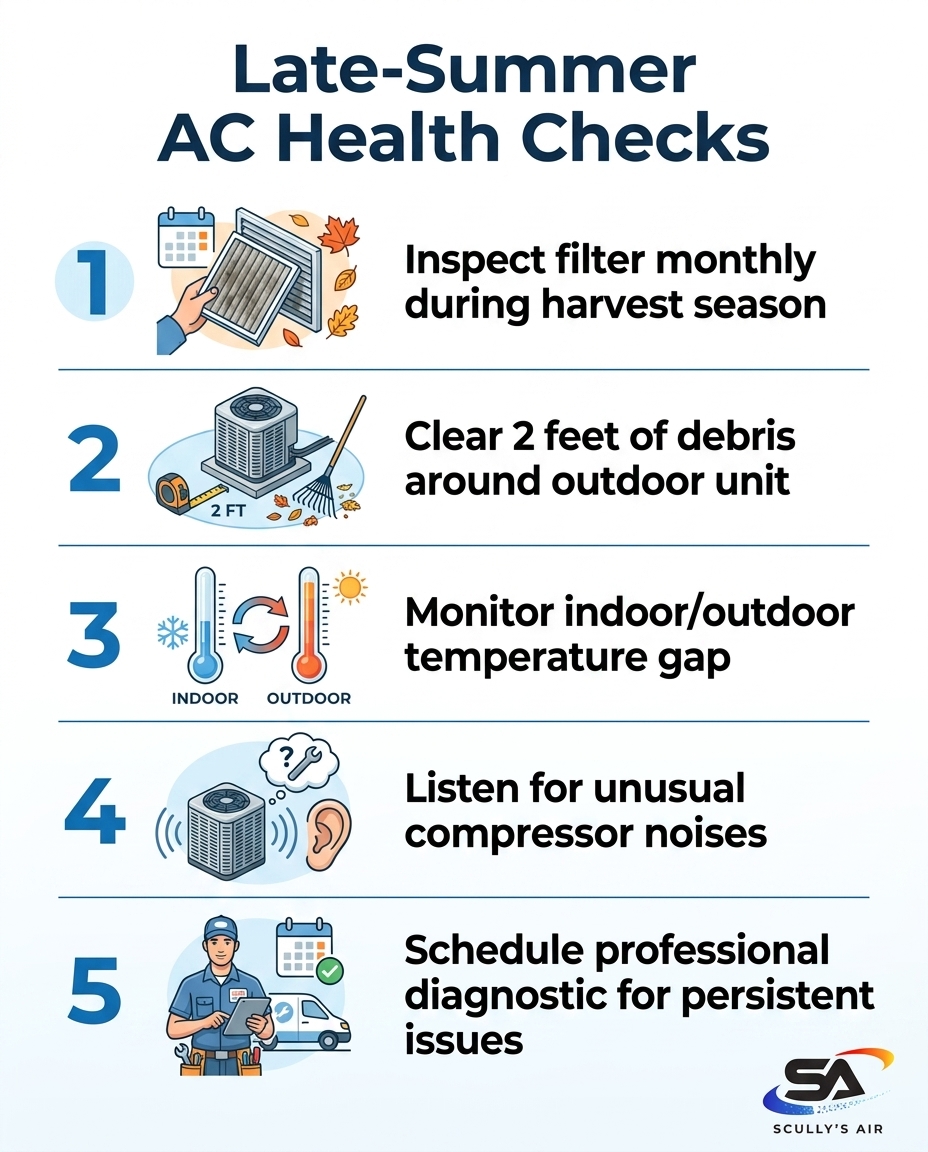
Start by performing a thorough visual inspection of the perimeter around your outdoor equipment. Over the course of the spring and summer, bushes grow, weeds sprout, and yard debris accumulates. Your system requires a strict two-foot clearance zone on all sides for optimal air intake.
Important safety warning: Homeowners should never open the protective cabinet or attempt to clean internal electrical components. Opening the unit exposes you to high-voltage capacitors and delicate refrigerant lines. Internal cleaning and electrical testing must always be left to a licensed professional.
Safe Exterior Cleaning Practices
You can safely address exterior airflow restrictions without opening the machine. Follow these steps to give your system room to breathe:
1. Clear the perimeter: Rake away dry leaves, grass clippings, and accumulated yard waste from the base of the unit.
2. Trim back vegetation: Prune any shrubs, bushes, or low-hanging branches that have encroached within 24 inches of the cabinet.
3. Wash the exterior gently: Using a standard garden hose with a standard spray nozzle, gently wash down the exterior fins to remove loose dust.
4. Avoid high pressure: Never use a pressure washer or a high-intensity jet setting. The aluminum fins are incredibly thin and will bend flat under high pressure, permanently blocking airflow and ruining the coil.
Checklist Item 2: Indoor Airflow and Harvest Season Filter Changes
While the outdoor unit handles heat rejection, your indoor unit is responsible for absorbing the heat from your rooms. This entire process relies on a steady, unrestricted volume of air passing through your return vents. The most common culprit for a system that runs constantly but fails to cool is a neglected indoor air filter.
We constantly remind our customers that the standard advice to change your filter "every 90 days" simply falls short in the Modesto / Central Valley region during peak agricultural activity. Harvest season kicks up massive amounts of dust and particulate matter, drastically reducing indoor air quality. During these high-use months, a filter can become completely clogged in just 30 days.
When a filter is clogged, the blower motor cannot pull enough warm air across the indoor evaporator coil. Without that warm air, the refrigerant inside the coil drops below freezing. The condensation on the coil turns to solid ice, completely blocking airflow and mimicking the symptoms of a failing compressor. The system runs endlessly, but no cold air comes out of the vents.
Choosing the Right MERV Rating
Selecting the right filter is a balancing act. You need to trap dust without suffocating your blower motor.
• The light test: Hold your current filter up to a bright light bulb. If you cannot see light shining through the material, it is time for a replacement.
• Avoid overly restrictive filters: Filters with a very high MERV rating (13 or above) are excellent at catching microscopic particles, but they can severely restrict airflow on older, aging systems.
• Keep backups on hand: Purchase high-quality pleated filters in multi-packs so you always have a fresh one ready during peak season.
Checklist Item 3: Evaluating the Indoor-to-Outdoor Temperature Gap
A pattern we see often on late-summer service calls is the frustration of watching the indoor temperature slowly climb while the air conditioner runs at full blast. Before you assume the system is broken, it is helpful to understand the realistic performance expectations of residential cooling equipment during extreme weather events.
Standard residential cooling systems are designed with specific limits. During August late-summer heatwaves, an indoor temperature of 78 degrees might actually mean your system is performing perfectly, provided the outside temperature is soaring past 100 degrees.
To evaluate if your system has a mechanical issue or is just dealing with heat strain, you can measure the temperature differential (also known as the "split"). Use a basic digital thermometer to measure the air temperature going into your return vent, and then measure the air coming directly out of a supply register.
Understanding System Design Limits
The laws of thermodynamics dictate how much heat your system can move at once. Understanding these rules helps set realistic comfort expectations.
• The 20-degree rule: Most residential systems are designed to maintain a maximum 20-degree difference between the outdoor temperature and the indoor temperature. If it is 105 degrees outside, an indoor temperature of 85 degrees means the system is maxed out.
• Thermostat myths: Setting your thermostat to 65 degrees will not make the system cool the house any faster. It simply forces the unit to run continuously in a futile attempt to reach an impossible goal, accelerating wear and tear.
• Healthy temperature splits: A healthy system should produce a temperature drop of about 15 to 20 degrees between the return air and the supply air. If the air coming out of your vents is only 5 degrees cooler than the air going in, you have a mechanical problem.
Checklist Item 4: Identifying Mechanical Warning Signs vs. Normal Heat Strain
Based on the countless emergency calls our team responds to in August, knowing the difference between a system that is working hard and a system that is actively dying can save you from a catastrophic breakdown. During the peak of summer in the Modesto / Central Valley area, your equipment will naturally sound louder and run longer. However, certain symptoms indicate that a professional intervention or an AC replacement might be necessary.
Listen closely to your outdoor unit when it starts up and while it runs. Normal operation includes a steady hum from the compressor and the smooth sound of the fan blade cutting through the air. Warning sounds are distinct, harsh, and hard to ignore.
Short-cycling vs. continuous operation: A system that runs continuously for hours on a 100-degree day is usually just trying to keep up with the heat load. However, a system that turns on for three minutes, shuts off abruptly, and turns back on five minutes later is "short-cycling." This is a major red flag indicating electrical issues, refrigerant problems, or severe overheating.
• Operational Sounds — Normal Heat Strain: Steady, continuous humming and fan noise — Mechanical Warning Sign: Grinding, metal-on-metal screeching, or loud buzzing
• Cycle Length — Normal Heat Strain: Running continuously during the hottest part of the day — Mechanical Warning Sign: Rapidly turning on and off (short-cycling)
• Airflow Quality — Normal Heat Strain: Warm air from vents only when first starting up — Mechanical Warning Sign: Blowing room-temperature or warm air for long periods
• Startup Behavior — Normal Heat Strain: Smooth transition when the thermostat calls for cooling — Mechanical Warning Sign: Loud clicking, dimming house lights, or a "hard start" struggle
When to Call a Professional Before Total Compressor Failure
There is a hard limit to what homeowner maintenance can achieve. Changing filters and clearing brush are excellent preventative measures, but they cannot fix a system that is fundamentally compromised. When you notice the warning signs from the checklist above during August late-summer heatwaves, delaying a professional diagnostic is a gamble that rarely pays off.
A professional diagnostic goes far beyond a simple visual check. Licensed technicians use specialized gauges to measure refrigerant pressures, multimeters to test the electrical draw of the compressor, and thermal tools to check for failing capacitors. Identifying a struggling component early can mean a simple repair instead of a total compressor failure.
At Scully's Air, our team is committed to precision installation and diagnostics. We know from daily field experience that guesswork leads to wasted money and repeated breakdowns. By relying on precise, data-driven diagnostics, we ensure long-term reliability for your home comfort. If a system is truly beyond repair, proper sizing and configuration during an HVAC installation become the ultimate solution for dependable cooling.
The Value of Precision Diagnostics
Guessing at the cause of a cooling issue often leads to replacing parts that are perfectly fine, while the root cause continues to damage the system.
• Refrigerant levels: An undercharged system will freeze up, while an overcharged system will destroy the compressor valves. Only a professional can measure and balance this precisely.
• Electrical integrity: A weak capacitor forces the compressor to pull massive amounts of amperage to start, slowly burning out the motor windings over time.
• Airflow mapping: Technicians can measure the static pressure of your ductwork to ensure the blower motor is moving the correct volume of air for your specific home size.
Frequently Asked Questions About Late-Summer Cooling Maintenance
What should be on a seasonal home maintenance checklist?
A comprehensive seasonal checklist should prioritize airflow and system health. Key items include replacing indoor air filters, clearing a two-foot perimeter around the outdoor condenser unit, and gently washing dry dust off the exterior fins. You should also test your thermostat functionality, check for unusual operational noises, and schedule a professional diagnostic if the system struggles during August late-summer heatwaves.
Why is my cooling system running constantly but not cooling the house?
When a system runs non-stop without lowering the temperature, it usually points to restricted airflow or a refrigerant issue. A completely clogged air filter or a thick blanket of dust on the outdoor coil prevents the system from transferring heat effectively. Alternatively, the system may be operating normally but has reached its design limit because the outdoor temperature is more than 20 degrees hotter than your thermostat setting.
How do I know if my compressor is failing?
A failing compressor often gives audible and electrical warning signs before it completely stops working. You might hear loud grinding, metal-on-metal screeching, or a heavy buzzing sound when the unit tries to start. Additionally, if you notice your house lights dimming significantly when the air conditioner turns on, the compressor is likely pulling too much electricity and struggling to start.
How often should you service your system during high-use months?
While a professional tune-up is generally recommended once a year in the spring, homeowner maintenance must increase during high-use months. In agricultural regions, you should check your indoor air filter every 30 days during the late summer and harvest season. Visually inspect the outdoor unit every few weeks to ensure yard debris and dust are not blocking the intake fins.
Can a dirty filter cause my system to stop cooling entirely?
Yes, a severely neglected air filter can completely halt your system's ability to cool. When the filter is clogged, the blower motor cannot pull enough warm air over the indoor evaporator coil. This lack of heat causes the refrigerant to drop below freezing, turning the condensation on the coil into a solid block of ice that completely blocks all airflow into your home.
Protecting Your Home's Comfort Through the End of the Season
Navigating the end of the cooling season requires a proactive approach to your home's mechanical health. By understanding the clear indicators of when a struggling system is experiencing normal heat strain versus when it is showing mechanical warning signs, you can make informed decisions about your comfort. The heavy agricultural dust and extreme temperatures of the Modesto / Central Valley region demand vigilance.
We encourage you to act on these checklist items immediately. Check your filter today, clear the space around your outdoor unit, and listen closely for any unusual sounds. If your system is failing to maintain a comfortable temperature or exhibiting any of the warning signs discussed, do not wait for a complete breakdown. Schedule your professional diagnostic before the season ends to ensure your equipment operates safely and efficiently when you need it most.


