
The September Dust Surge in Central Valley Homes
Data from the San Joaquin Valley Air Pollution Control District routinely shows severe spikes in PM10 and PM2.5 particulate matter during the early fall harvest. When you are navigating Central Valley harvest season dust, a first-hand look inside Modesto ductwork reveals exactly why early fall air quality takes such a severe toll on local homes. Almond and walnut harvesting in Stanislaus County kicks up massive clouds of fine agricultural silt, and the dry, windy climate of the Central Valley in early fall drives this particulate matter straight into residential neighborhoods.
If you need help protecting your air conditioning systems or are looking for professional Modesto duct cleaning, our team is ready to assist.
The central dilemma for homeowners in this region is a matter of balance. You need to block this heavy agricultural dust from circulating through your living spaces, but doing so improperly can actually choke your HVAC system. Managing this seasonal surge requires more than just standard filter changes; it requires a strategic approach to filtration and airflow management. As the tractors roll through the orchards, the dust they generate doesn't just stay in the fields. It finds its way through tiny gaps in your home's envelope, pulling into your return vents and settling deep inside your system.
The Climate Factor in the Central Valley
The specific weather patterns of early fall exacerbate the spread of this dust. After months of hot, dry summer weather, the soil in the Modesto area is completely parched. When harvesting equipment shakes the trees and sweeps the orchard floors, the resulting silt is exceptionally light and dry. Afternoon breezes easily pick up this fine material, carrying it miles away from the source. Because the early fall (September) harvest season often still brings warm temperatures, local HVAC systems are running frequently, constantly drawing this compromised outside air into the home's circulation loop.
What Harvest Season Particulates Actually Look Like Inside Your System
Based on neutral, expert field observations from actual Modesto duct inspections, the buildup during harvest season looks very different from standard household dust. Typical indoor dust is largely composed of dead skin cells, fabric fibers, and pet dander. It tends to be fluffy and relatively easy for a standard filter to catch. Agricultural silt, on the other hand, is entirely different.
This fine, powdery dirt from Modesto and Central Valley agricultural zones bypasses low-quality fiberglass filters with ease. Once it gets past the filter rack, it enters the ductwork and coats the interior walls. Technicians inspecting local systems during September and October consistently note a thick, restrictive layer of brown or gray silt clinging to the sides of the ducts. Because this dust is so fine, it behaves almost like a liquid when airborne, finding its way into the tightest crevices of your HVAC equipment.
The Anatomy of Agricultural Buildup
• Blower Wheel Impaction: The curved blades of your blower motor act like a centrifuge. As fine silt passes through, it packs tightly into the curve of the blades, changing their aerodynamic shape and drastically reducing the amount of air the fan can move.
• Evaporator Coil Coating: The indoor coil is often slightly damp from condensation. When dry agricultural dust hits this wet surface, it turns into a muddy paste that bakes onto the aluminum fins, blocking the transfer of heat.
• Ductwork Stratification: In horizontal duct runs, the heaviest dirt settles on the bottom, creating a permanent layer of soil that standard airflow cannot dislodge, while the finer particles continue to recirculate into your living room.
The rapid accumulation rate observed during peak harvest weeks means a system that was perfectly clean in August can be heavily compromised by late October if the filtration strategy fails.
The High-MERV Filter Dilemma: Protection vs. Suffocation
To combat the heavy dust load, many homeowners immediately upgrade to a high-MERV (Minimum Efficiency Reporting Value) filter. These pleated filters are designed with incredibly dense media to trap microscopic particles, making them a common recommendation for improving indoor air quality. However, during extreme dust events, these filters introduce a counter-intuitive technical risk.
The physics of static pressure dictate how your HVAC system breathes. Static pressure is the resistance to airflow within your ductwork. A high-MERV filter naturally creates more resistance than a cheaper, porous filter. As that dense filter successfully catches the massive volume of fine agricultural silt pulled from the Modesto air, its microscopic pores plug up rapidly. Within a matter of weeks, the filter transforms from an air purifier into a physical barrier.
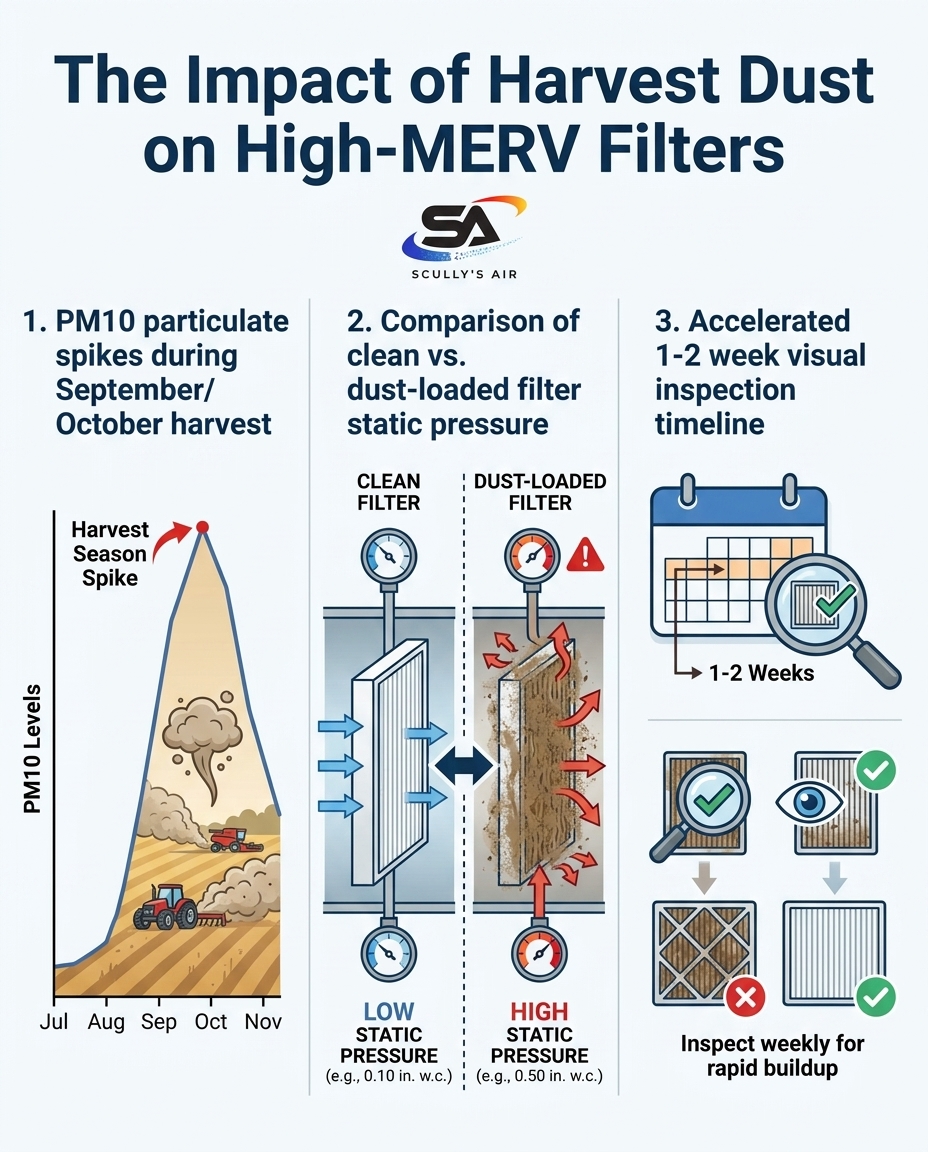
When a filter becomes prematurely clogged, it leads to suddenly restricted HVAC air flow. The blower motor is forced to work exponentially harder to pull air through the system. While the filter is technically doing its job by blocking the dust, it is simultaneously suffocating the equipment if left unchecked. Airflow restriction and static pressure drop from rapid dust loading are among the most common causes of unexpected system failures during the early fall.
Recognizing the Signs of Rapid Static Pressure Drop
Detecting airflow restriction early can save your equipment from severe damage. Because a high-MERV filter can plug up so quickly during harvest season, you cannot rely on the calendar to tell you when there is a problem. Instead, you need to monitor the physical symptoms your system displays.
The physical signs of static pressure drop include:
• Weak airflow from vents: If you hold your hand over a supply register and barely feel a breeze, the system is struggling to push air through the house.
• Unusual whistling noises: A clogged filter forces the blower to pull air from any available gap. This often causes a high-pitched whistling sound at the return grille as air squeezes past the edges of the plugged filter.
• Constant running: Because the system cannot move enough conditioned air to satisfy the thermostat, it will run continuously without actually cooling or heating the home effectively.
• Hot spots and cold spots: Rooms furthest from the central unit will stop receiving adequate air entirely, leading to uneven temperatures across the house.
The Danger to Your Blower Motor
When airflow is choked off, the blower motor lacks the air circulation it needs to keep itself cool. This strain leads to overheating. On a warm early fall afternoon, an overheating motor will trip its internal thermal overload switch, resulting in an unexpected system shutdown right when you need it most. Monitoring these symptoms closely during harvest season is essential to protect the longevity of the equipment. Addressing these signs proactively is a critical part of routine AC maintenance during the transition into fall.
Why Standard Filter Replacement Schedules Fail in September
One of the most persistent myths in home maintenance is that checking your HVAC filter every 90 days is sufficient. While that rule of thumb might work in coastal areas or during the mild spring months, it completely fails for Central Valley homes during the fall. The early fall (September) harvest season creates an environmental anomaly that renders standard advice useless.
During the September and October harvest surge, a high-MERV filter can reach maximum capacity in just two to three weeks. The sheer volume of particulate matter in the air overwhelms the surface area of the filter media. If you wait 90 days to check it, your system will spend two solid months operating under severe static pressure strain.
Implementing an Aggressive Monitoring Schedule
To protect your system, you must adopt a visual inspection schedule tailored to the local environment. We recommend checking the filter every 1-2 weeks during active harvesting in nearby agricultural zones.
• Filter Inspection Frequency — Standard Season (Winter/Spring): Every 30 to 90 days — Harvest Season (Sept/Oct): Every 7 to 14 days
• Filter Replacement — Standard Season (Winter/Spring): When visibly gray or dusty — Harvest Season (Sept/Oct): Immediately upon a solid coating of silt
• MERV Rating Recommendation — Standard Season (Winter/Spring): MERV 8 to 13 (based on system) — Harvest Season (Sept/Oct): Balanced for airflow (consult technician)
It is also vital to balance your filter's MERV rating based on your system's specific airflow capacity. Simply buying the highest rating available at the hardware store is often a mistake. A technician can measure your system's static pressure and recommend a filter that catches the agricultural dust without suffocating the blower motor.
Professional Intervention: Removing Agricultural Silt from Ductwork
Even with vigilant filter changes, some fine agricultural silt will inevitably bypass the filter rack—especially if the system was operated with a clogged or collapsed filter in the past. Once this dust settles in the ductwork, standard airflow will continually pick it up and recirculate it into your living space. This creates a cycle of poor indoor air quality that vacuuming and dusting your furniture can never fully resolve.
Removing this compacted silt requires specialized intervention. DIY cleaning is highly limited and often ineffective. Standard household vacuums cannot reach deep into the duct runs, and attempting to open sealed ductwork yourself can cause permanent damage or create new air leaks. Furthermore, dislodging this fine dust without the proper negative air equipment simply blows it back into your home.
How Professionals Restore Airflow Dynamics
Specialized equipment is required to safely dislodge and extract fine silt from deep within the duct runs. Professional technicians use high-powered negative air machines to place the entire duct system under suction. Then, they introduce pneumatic agitation tools that gently scrub the interior walls of the ducts, breaking the bond between the baked-on agricultural dirt and the duct material. The negative pressure immediately pulls the loosened dust out of the house into a contained filtration unit.
This level of professional vent cleaning restores proper airflow dynamics and removes the accumulated particulate load. If you live in Modesto or the surrounding Central Valley agricultural zones and have experienced severe dust infiltration or prolonged periods of restricted airflow, having your ductwork inspected professionally is the most effective way to reset your system for the coming winter.
Modesto Homeowner FAQs: Managing Harvest Dust
Why is it so dusty in the Central Valley during early fall?
The spike in dust is caused by the combination of intensive agricultural harvesting activities and local weather patterns. During September and October, heavy machinery sweeps the dry orchard floors to harvest almonds and walnuts. The region's dry, windy conditions then pick up this fine particulate matter and carry it across residential neighborhoods.
Can a high MERV filter restrict airflow and damage my HVAC system?
Yes, a high-MERV filter can severely restrict airflow if it is not monitored carefully. When rapidly loaded with fine agricultural silt, the dense filter media becomes blocked, causing severe static pressure drops. This forces the blower motor to overwork, which can lead to overheating, increased energy consumption, and premature system failure.
How often should I check my HVAC filter during harvest season?
You should visually inspect your filter every 1-2 weeks during the peak harvest months of September and October. The standard advice of checking filters every 30-90 days does not apply during this period of extreme dust loading, as a filter can reach full capacity in a matter of days.
What does agricultural dust do to ductwork over time?
Agricultural dust coats the interior walls of the ductwork, creating a thick, restrictive layer of silt. Over time, this buildup reduces the efficiency of the HVAC system by narrowing the air path and continuously recirculates fine particulates into your living space, degrading your indoor air quality.
What is the best way to protect my HVAC from farm dust without choking the motor?
The best approach is a balanced strategy. Use an appropriately rated filter that matches your system's specific airflow capacity, monitor it aggressively every week during the harvest, and schedule seasonal professional inspections to ensure the blower wheel and evaporator coil remain clean.
Securing Your Indoor Air Quality This Harvest Season
Surviving the Central Valley harvest season requires a proactive balance between aggressive filtration and maintaining healthy system airflow. When navigating Central Valley harvest season dust, a first-hand look inside Modesto ductwork proves that leaving your system to fend for itself is a recipe for poor air quality and strained equipment. By monitoring your filters closely and addressing existing dust buildup in your ducts, you protect both your respiratory health and your valuable HVAC investment.
If you suspect your system is struggling with the seasonal dust load, or if your home feels constantly dusty despite your best efforts, do not wait for the blower motor to fail. Schedule an inspection or professional cleaning today to ensure your system is breathing freely and your indoor air remains clean all season long.


